

#36 - Your Minimum Viable Exposure
How to train yourself to act despite fear

When you finish a leadership development programme, you’re energised and ready to apply what you’ve learned. Then you go back to work, try out your new skills, and hit resistance: from stakeholders, from systems, from that voice in your head saying “maybe I’m not ready for this after all.”
This week I spoke to fifty women product leaders at Sage who’d just completed a ten-month leadership development programme. They’d learned to overcome imposter feelings, build influence, and navigate bias. Now they were facing exactly this moment: what happens when the bubble bursts and the real world pushes back?
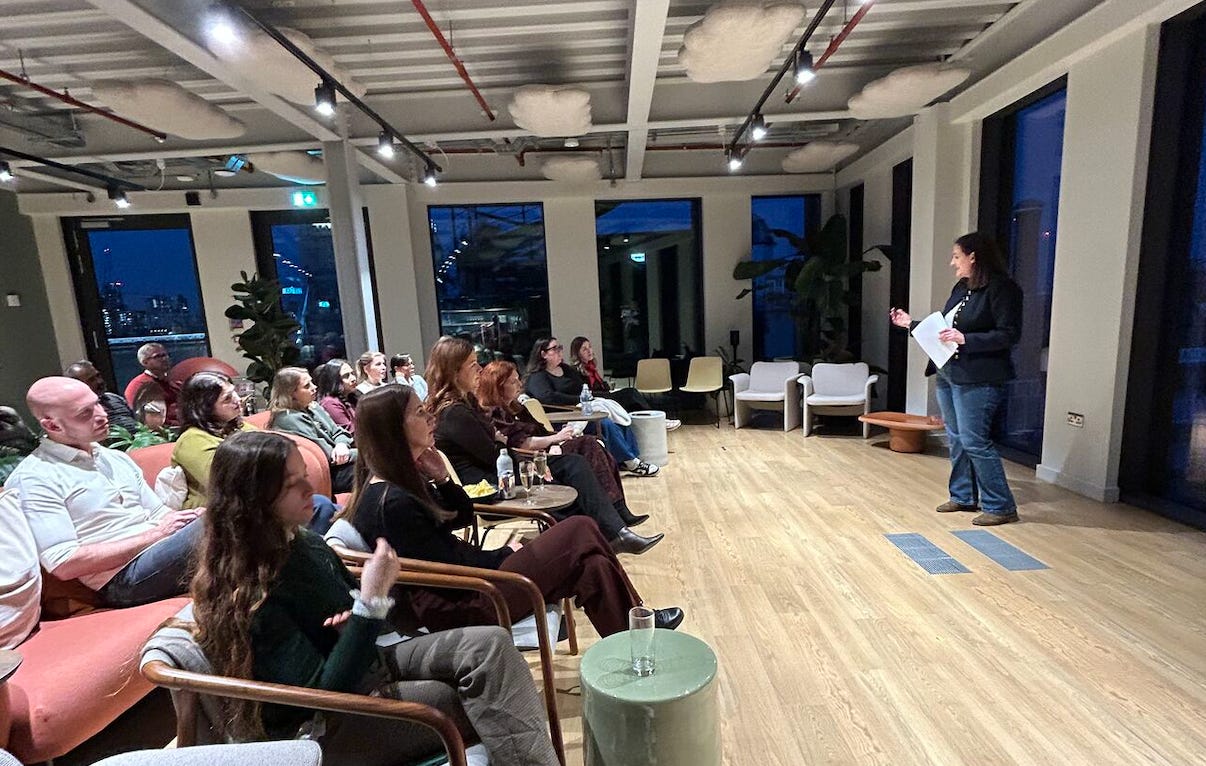
Here’s what I shared with them about managing fear when growth gets hard.
Takeaway 1: Recognise how fear shows up
Whenever you go on a course or take part in a programme, you fall into a bubble — a safe yet artificial environment where you can learn and practice new skills without real-world consequences. It’s absolutely necessary to have this bubble, but it bursts as soon as you go back to your ‘day job’ and encounter resistance the first time you try to put those new skills into practice.
People are messy. We don’t always behave in predictable ways, so conflict is inevitable somewhere along the line. How do you react when that happens?
We experience fear when we perceive a threat in our environment: what used to be physical threat with the tiger in the bush, is now identity threat and social threat — who we think we are, and whether we belong to the tribe.
Fear is an automatic response, and it shows up in business, sometimes in really subtle ways. Here’s what those four fear responses can look like:
Fight: you get defensive. Example: your manager gives you developmental feedback and your immediate reaction is ‘that’s not true, that doesn’t apply to me’.
Flight: you avoid a situation. Example: running away to some unknown future when you say ‘I need to learn more about this first, then I will feel ready’.
Freeze: you feel stuck in place. Example: you’re in a high stakes meeting and have a point to make but you keep it to yourself because you’re worried you’ll look silly.
Fawn: you appease the source of the threat, becoming very agreeable. Example: a senior stakeholder is voicing their opinion strongly and you disagree with them, yet you publicly agree with them to avoid the confrontation.
So when those threats arise, that fear will manifest a physiological response — heart racing, palms getting sweaty, mouth going dry. What if instead of succumbing to one of those four responses, we noticed this happening and got curious about it instead? This is what I mean by using fear as information — ask yourself: what is the threat here? Name the fear as a starting point.
Takeaway 2: Confidence is the practice of managing fear
Those physiological responses arising from fear (or any emotion, actually) only last about 90 seconds. What keeps them going for longer is continually re-engaging with the thought that created them. So, if you can sit with that fear for 90 seconds, you will notice that it starts to dissipate, loosen its hold on you. And eventually it will disappear.
I shared an example from space to illustrate this. Chris Hadfield is a Canadian astronaut, and former Commander of the International Space Station. As part of his time onboard in 2001, he conducted several space walks, where you suit up and go outside the station to perform maintenance. On one occasion, he recalls facing the ISS, with the Earth behind him, holding on by just one hand.

When all of a sudden, some liquid shoots into his eye, blinding him. He can’t wipe it away because he’s wearing his helmet. He can feel the gunk collecting in his eye and he can’t open it. It hurts. And then because of the effect of microgravity on surface tension of liquids, it starts moving across the bridge of his nose into his other eye, rendering him completely blind.
Imagine that — holding on to the space station with one hand, not able to see anything. What’s your reaction? Fear I expect, as the survival instinct kicks in. But fear in that situation can cause panic, and Chris didn’t do that. He was trained to recognise fear, and then manage it.
Astronauts go through extensive training over many years, not just for the technical aspects of the role like how to use equipment, but also the psychological. They repeat procedures over and over again — not just what to do if it all goes right, but also what to do when things go wrong. And because of that, they’re prepared for the worst case scenario. In this situation, Chris called over to his crewmate on the space walk with him, and together they got him back inside where he could get help. It turned out it was defogger fluid that had landed in his eye.
What this shows is that Chris wasn’t born fearless. Instead, he trained his response to fear, so it didn’t overwhelm his body and impact his ability to make decisions under extreme pressure.
And this is what I believe true confidence is: not the absence of fear, but acting regardless when it is present.
Confidence is the practice of managing your fear — noticing how it feels in your body, having a toolkit of techniques to reduce its potency (e.g. box breathing, mindfulness, movement), and staying with it until it subsides.
Takeaway 3: Use MVE to train your fear response
So how can we proactively overcome our fears? We can look to exposure therapy, which is a type of treatment used for phobias, for inspiration. A therapist will work with you, progressing you through a series of steps to expose you to the very thing you’re scared of.
Say you have a fear of snakes. You might start with just looking at a picture of one whilst you’re sat safely at home. There’s no way that snake can harm you, yet the fear sensations are triggered. Stay with them and you notice they go away. You keep repeating this until you can look at the picture without the fear response kicking in.
Then you progress to watching a video of a snake. Once you’re comfortable with that, you look at one in real life behind glass at a zoo. Then perhaps someone else holding one whilst you’re nearby. Eventually, you might hold one yourself.
It takes time, persistence and repeated exposure to the very thing that spikes your fear. But what this technique shows is that it’s possible to get comfortable with feeling uncomfortable, and we can apply this to situations at work.
You may be familiar with the concept of minimum viable product — developing a product hypothesis, and then building the smallest thing to test it. The beauty of MVP thinking is that it removes the pressure to get everything perfect upfront. You learn by doing, iterate based on feedback, and gradually build towards the bigger goal.
We can apply this same kind of thinking to managing our fear, in what I call Minimum Viable Exposure. What’s the smallest step you can take this week that stretches you just beyond your comfort zone, where you feel that fear starting to spike, but where you’re actually quite safe? Where the consequences are reversible, or low stakes?
Just like with MVP, you're not trying to nail it in one go. You're testing, learning, building your capacity to manage fear incrementally.
My own example was when I first presented to a board about 8 years ago. The Deputy Group CEO asked me to speak about a critical turnaround: we had one client representing 85% of our business who was unhappy due to repeated delivery failures. I had been brought in to fix it, leading a team with low morale and capability gaps. When I thought about presenting to the Board, I was intimidated — it felt like stepping into the Dragon’s Den! — and I worried that I wouldn’t be able to answer their questions and would look like I didn’t know what I was doing.
So I broke the task down into smaller chunks. First, I wrote out my key messages just to get clear on what I needed to say, and got feedback from the Deputy CEO. I met with him face to face, and this became my first MVE. His feedback helped me refine the core message. Then I shared this with my team, more for the speaking practice, to get used to what I was saying coming out of my mouth — my second MVE. Of course, the Execs wanted to know what I was going to present, so they invited me to their next meeting — my third MVE. Their questions helped me refine and shape my message further.
At every step I felt that fear - what if I say something wrong? But each step built up to the Board presentation, so when the time came it wasn’t as scary as I’d anticipated — and actually went very well. Had I not done the prep it could have been a very different outcome.
Final thoughts
This coming week there will be a moment when you hesitate, where that fear has triggered one of those four responses automatically in your body. That moment is the moment — your cue not to retreat but to lean forwards. It signals that you’ve reached the edge of your current self, and are stepping into growth.
So here’s my challenge: identify your Minimum Viable Exposure for this week. What’s one small step that scares you just enough? The message you’ve been putting off sending? The question you’ve been afraid to ask? The conversation you’ve been avoiding?
Pick one. Do it. Notice what happens.
Growth doesn’t come when we live in our comfort zones. This isn’t something anybody can do for you - not your manager, coach or best friend - only you have the power to do this for yourself. As Susan Jeffers wrote: feel the fear, and do it anyway.